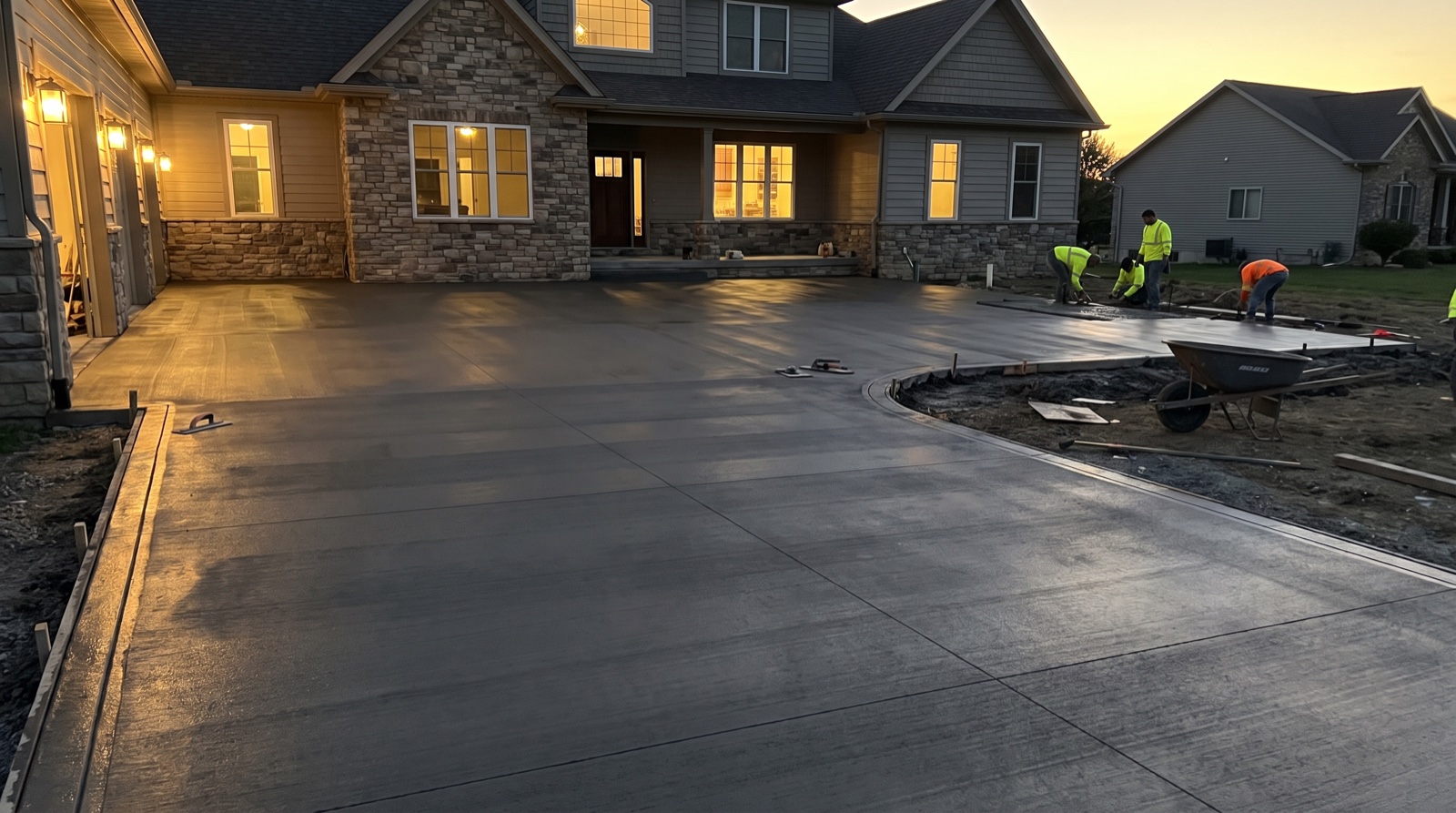
A Concrete Driveway Lasts 30 to 50 Years
A properly built concrete driveway runs 30 to 50 years before it needs full replacement. A poorly built one starts breaking apart in 10 to 15.
That spread is wide because lifespan is mostly decided on pour day and then defended by maintenance. The concrete itself does not guarantee either end of the range.
What Actually Sets the Number
Five factors do almost all the work. Get them right and the slab outlives the mortgage.
- Subbase preparation. Four to six inches of compacted road base keeps the slab from settling unevenly once the ground moves.
- Slab thickness. Four inches handles passenger cars. Five or six inches is what you want if a truck, RV, or loaded trailer parks there.
- Mix design. A 4,000 PSI air entrained mix survives freezing weather far better than a bargain mix.
- Reinforcement. Rebar or fiber does not prevent cracking. It holds the pieces tight so cracks stay hairline instead of opening up.
- Drainage. Water sitting against or under a slab is the most common reason driveways fail early.
Every one of those is settled before the truck leaves the yard. That is why the crew doing your driveway installation matters more than any product you can buy at the hardware store afterward.
Colorado Weather Is Hard on Slabs
Colorado Springs sits above 6,000 feet and swings through freeze and thaw cycles constantly from October through April. A sunny 50 degree afternoon followed by a 20 degree night can happen dozens of times each winter.
Each cycle pushes moisture into the concrete, freezes it, and expands it slightly. Air entrained concrete gives that ice somewhere to go, which is why the mix matters so much along the Front Range.
Expansive clay soils add a second problem. Soil that swells when wet and shrinks when dry lifts and drops sections of slab, which is the same pressure that shows up in foundation work across El Paso County.
Then there is the sun. Thin air means stronger UV, and UV breaks down surface sealers faster here than it does at sea level.
The Maintenance Schedule That Adds Years
| Task | How Often | Why It Matters |
|---|---|---|
| Reseal the surface | Every 2 to 3 years | Blocks water and deicer chemicals from soaking into the slab |
| Check and refill control joints | Every fall | Keeps water out of the one place it is designed to enter |
| Clear drainage and downspouts | Spring and fall | Stops water from pooling at slab edges and undermining the base |
| Rinse off winter residue | Every spring | Removes salt and magnesium chloride before they eat the surface |
| Fill new cracks | As they appear | A sealed hairline crack stays hairline |
Sealing Cadence
Two to three years is the right interval for most Colorado Springs driveways. South facing slabs with full afternoon sun sometimes need it closer to every two.
Use a penetrating silane or siloxane sealer rather than a glossy film. Penetrating sealers protect from inside the pores and will not peel or turn slick when wet.
There is a simple test. Splash water on the surface, and if it soaks in instead of beading, the sealer is done working.
Joints Are Not Decorative
Those grooves cut into your driveway are control joints. They tell the slab where to crack so it cracks in a straight, planned line instead of a random one.
They only work if they stay sealed. Open joints collect water, grit, and weed roots, and that trapped moisture freezes and pries the edges apart.
Refill them with a flexible polyurethane joint sealant, not rigid mortar. The joint needs to move with the slab.
Habits That Quietly Shorten Lifespan
- Rock salt. Sodium chloride accelerates surface scaling. Sand or a magnesium chloride product with less residue is easier on the concrete.
- New concrete through its first winter. Skip deicers entirely for the first full year while the slab finishes curing.
- Metal plow blades. They gouge the surface and strip sealer. Use a rubber edged blade or a shovel.
- Sprinklers hitting the edge. Constant water at the perimeter softens the base underneath.
- Tree roots. Mature roots lift slabs the same way they lift sidewalks and walkways, and the damage is slow enough that most homeowners notice it too late.
When the Clock Is Actually Running Out
Hairline cracks, minor surface wear, and small spalled patches are maintenance items. They do not mean the driveway is finished.
Real end of life looks different. Watch for cracks wider than a quarter inch, sections that have settled more than an inch out of plane, widespread crumbling that exposes aggregate, or cracks that keep reopening after being filled.
One or two of those usually mean targeted concrete repair still makes sense. All of them together usually mean the base has failed, and no surface work fixes a bad base.
At that point removing the old slab and rebuilding the subbase is the cheaper decision over the next 30 years, even though it costs more this month.
Getting a Straight Answer About Your Driveway
Most homeowners can judge sealing and joint condition themselves. Judging whether the base underneath is still sound takes a look at how the slab is moving, not just how it looks.
If you are unsure which side of that line your driveway falls on, get in touch for an honest assessment before you spend money on either option. We serve Colorado Springs, Monument, Fountain, Pueblo, and the rest of El Paso County, and we will tell you if maintenance is still the right call.