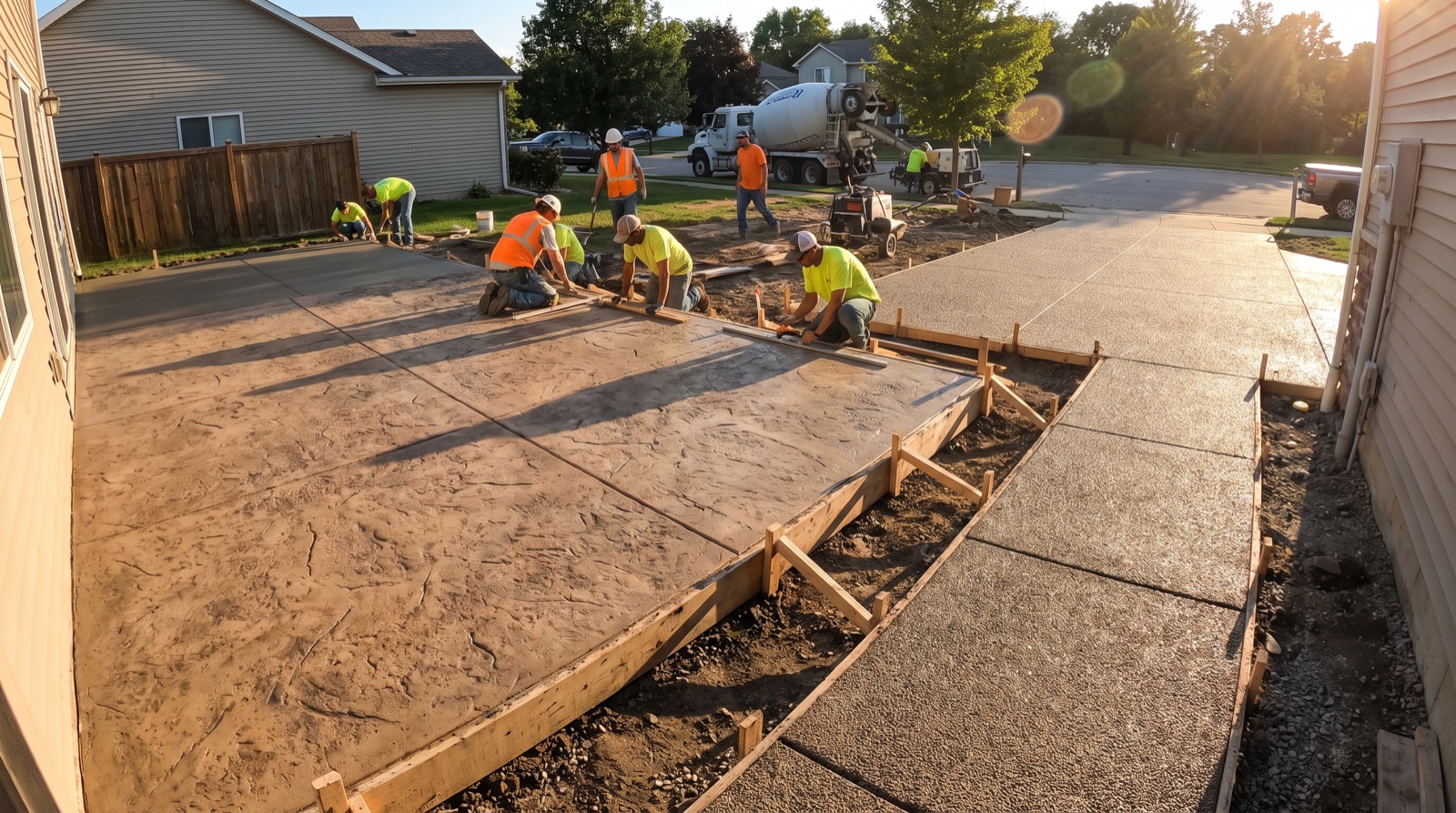
For most Colorado Springs homeowners, a poured concrete patio is the better choice. It costs less to install, needs less upkeep, and holds up well in our climate when the base and joints are done right.
Pavers make sense if you want the easiest possible spot repairs and you are comfortable paying more up front. The right answer depends on your budget, your soil, and how much maintenance you want to take on.
Quick Comparison
| Factor | Poured Concrete | Pavers |
|---|---|---|
| Installed cost | $8 to $14 per sq ft | $18 to $30 per sq ft |
| Typical lifespan | 25 to 40 years | 30 to 50 years |
| Upkeep | Low | Moderate |
| Spot repairs | Harder to hide | Easy to blend |
| Install time | 2 to 4 days | 4 to 7 days |
These are typical ranges for the Front Range, not a quote. Site access, slope, and soil conditions move the numbers in both directions.
Upfront Cost
Concrete wins on price. A plain broom finished slab usually costs about half of what a comparable paver patio does, because pavers require deeper excavation, more base material, and hand setting of every piece.
On a 400 square foot patio, that gap often reaches several thousand dollars. Decorative finishes narrow it, but stamped concrete at roughly $14 to $22 per square foot still tends to come in under pavers.
If an old slab or deck footing has to come out first, demolition and haul off adds to the cost of either option. Ask for that line item to be listed separately so you can compare bids fairly.
Longevity
Individual pavers are extremely dense and can outlast a slab. The surface as a whole is a different story, because it depends on the base and the joint sand staying put.
A properly poured patio lasts 25 to 40 years with basic care. What shortens that life is almost always a thin slab, a poorly compacted base, or water pooling against the edges.
Pavers rarely fail outright. They drift, settle, and develop low spots that need to be lifted and reset every several years.
Repair Ease
This is where pavers have a real advantage. A stained, cracked, or sunken section can be pulled up, the base corrected, and the same pieces laid back down with no visible seam.
Concrete repairs are effective but harder to disguise. Cracks can be routed and sealed, sunken sections can be lifted, and worn surfaces can be resurfaced, yet a patch seldom matches the original color exactly.
The tradeoff is frequency. A well built slab may need professional crack or surface repair once or twice in its life, while pavers ask for small corrections far more often.
Aesthetics
Pavers offer natural texture, color variation, and patterns like herringbone or basket weave. Many people like the look of individual units and visible joints.
Concrete is more flexible than its reputation suggests. Integral color, exposed aggregate, and stamped patterns that mimic flagstone or slate give you a custom look on a single continuous surface.
That continuous surface matters in daily use. There are no joints for weeds or ants to move into, and patio furniture sits level without rocking.
How Each Handles Colorado's Climate
Colorado Springs is hard on flatwork. At more than 6,000 feet we get intense UV, hail, and winter days that swing from freezing nights to sunny afternoons again and again.
Parts of El Paso County also sit on expansive clay that swells when wet and shrinks when dry. Both materials have to be built for that movement.
Concrete in CO conditions
- An air entrained mix resists damage from repeated freezing and thawing.
- A compacted gravel base and a minimum 4 inch slab limit settling.
- Control joints placed at the right spacing direct cracks where they will not show.
- Sealing every two to three years protects the surface from moisture and sun fade.
Pavers in CO conditions
- Joints let the surface flex with soil movement instead of cracking.
- That same flex leads to uneven heaving and low spots on clay soils.
- Summer thunderstorms wash out joint sand, which then needs to be replaced.
- Edge restraints can loosen after a few winters and let the border spread.
Neither option is immune to bad drainage. Whatever you choose, the patio needs to slope away from the house so snowmelt does not sit against the foundation.
Which Should You Choose?
Choose poured concrete if:
- You want the lowest installed cost for the space.
- You prefer a surface you can sweep, hose off, and reseal occasionally.
- You want a decorative finish without the price of stone or pavers.
Choose pavers if:
- Seamless spot repairs matter more to you than low upkeep.
- Your budget comfortably covers the higher install cost.
- You do not mind refilling joint sand and resetting sections over time.
For most yards from Monument to Fountain and Pueblo, a well built concrete patio delivers the best balance of cost, durability, and appearance. If you want numbers for your own space, get in touch for a free quote or call (719) 666-9608.